@kaia@jeder I was curious as to how unrealistic both options are.
I will be using a flight from KJFK (New York City) to KBOS (Boston) on a Embraer 175LR fueled with A1 jet fuel (commonly used in America), departing on 9:00 today (24-03-08) as an example, I'm using aviapages.com for numbers, though I'm converting some units.
Just some quick numbers: the peek power usage is about 34 MW the total power usage is about 37 GJ or 10 MW h the distance is 303 km
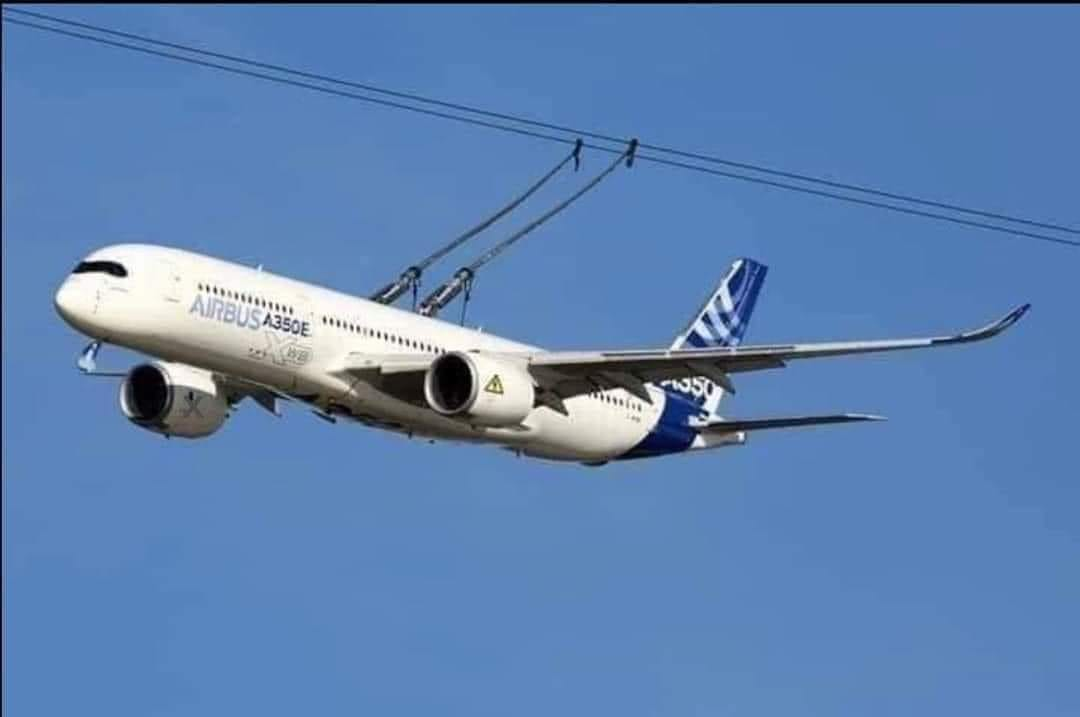
Overhead plane lines
Very hard to achieve. Some issues: the pilot would have to keep the plane attached to the cable , which presumably is difficult assuming CuMg0.5 150mm2 is used for the wires , as it commonly is for overhead lines , which weighs 1.334 Gg/km , the entire cable would weigh 404.051 Gg the height the cable is at is over 3 magnitudes higher than any currently existing power pylons , thus requiring they be kept in the air in some floating structure , which is also hard[citation needed]
anyway lets ignore that idea
Laser energy transfer
this seems like such a better idea right?
Well um yeah we need to transfer at least 34 MW . for reference , the laser shown is the Tactical High Energy Laser prototype , which was in fact a prototype anti-air laser . Unfortunately I could not find its power output , however another anti-air prototype laser , the Mid-Infrared Advanced Chemical Laser was able to output over a megawatt for 70s . so yeah you need like 30 of those per firing group
@jeder Was pretty wild seeing the footage yesterday of the 777 departing San Francisco for Japan have a tire literally fall off after takeoff, and get rerouted to LAX. 😳 🛞
It would be more efficient if we chained a few of these planes up in a line. Like a... convoy of ships! Maybe you wouldn't even need the engines on the extra ones, the one in front could pull them all! Like a ...n 18 wheeler truck
@jeder 100% yes. Hang the pantograph off the bottom, now you have a renewables powered land ekranoplan that doesn't have to carry 200T explosive petrochemicals. Bonus: infra now cheaper to build than high speed rail, with intrinsic vertical separation.



 1😆3
1😆3 1
1 1
1 2🥴2🤩1🚡24
 1❤24⭐597
 1
1 1
1 1😇1
1😇1 1
1 1
1 1😹3
1😹3